Food Without Salt
On keeping a Vaidika practice in New Jersey, and why a dharma that is chosen is held more firmly than one that is simply inherited.
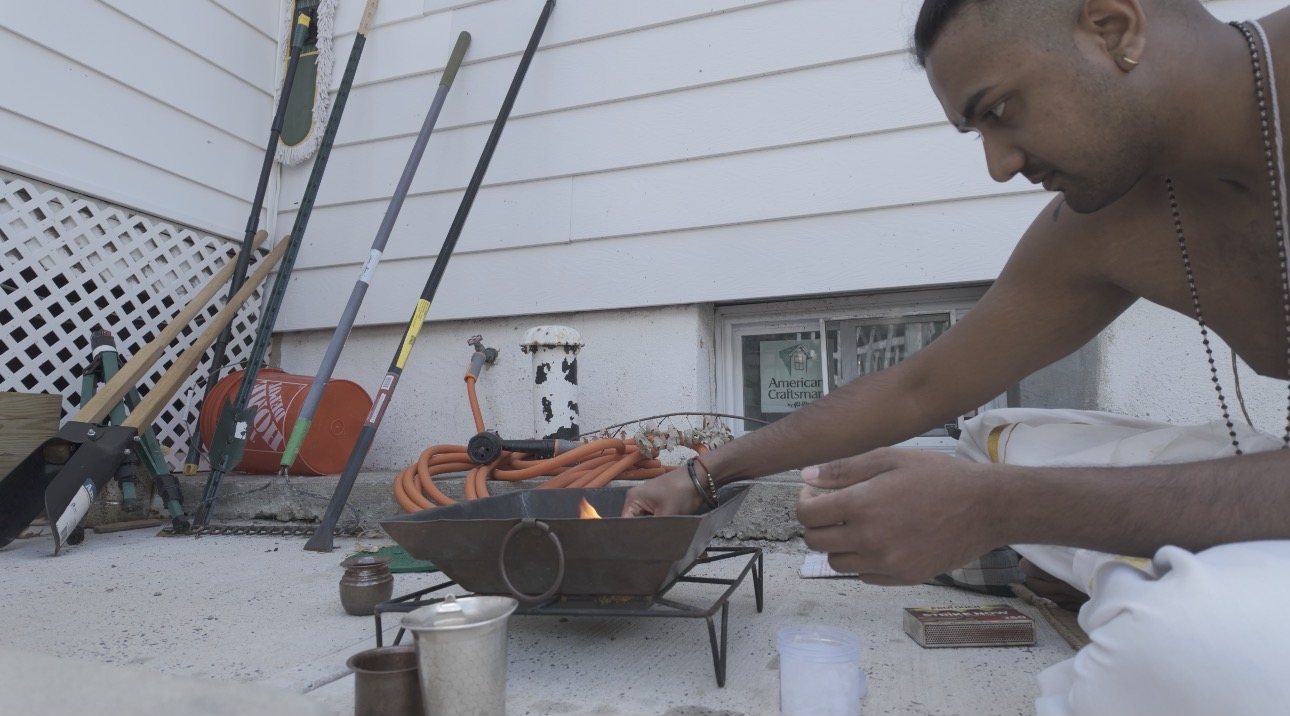
It had snowed the night before, and the yard behind my house was white and quiet. I walked out in my veshti with a shawl around my shoulders and a small bundle of samit in my hand, the dry twigs that are offered into agni. It was too cold and too wet to kindle agni in the open, and so I did samidhadanam inside my greenhouse instead. I expected it to be miserable. Rather, it felt refreshing, almost like camping, with the snow outside the glass and the small agni in front of me.
I restarted this practice in October 2024. Most mornings nobody sees it except my family. Even so, every time I offer the samit into agni, or pour arghya to the Sun, I am reminded that I belong to a Vaidika parampara far older than me. I am also reminded that this parampara did not stay behind in India when I came to America at fourteen. In India, I never had to choose it. Here, I choose it every morning.

There is a Kannada saying, uppiginta ruchi illa, “there is no taste greater than salt”. Salt is a strange thing. Nobody praises it when it is there, and yet everyone notices the moment it is missing. A meal without salt is still a meal, but nothing in it tastes right. Dharma works the same way. In India, it is everywhere, in the temple bells, the rivers, the countless shrines, the festivals and the tilak or bindu on people’s foreheads. Hence, it is easy to stop noticing it. It is a bit like living on the banks of the Ganga. When the river flows right past the house, one rarely thinks of going down to bathe in it.
Leaving India takes the salt away. For many people, dharma then fades without their noticing. For those who do notice, however, something changes. Dharma stops being something they inherited and becomes something they choose. Hence, my claim is simple. A dharma that is chosen, rather than simply inherited, is held more deliberately, explained more clearly and defended more firmly. This is true of Hindus in America, and more and more, it is becoming true of Hindus in India as well.
In my family, we often say that America is becoming more Hindu while India is becoming more Western. This is what I see around me. My circle is the local temples, Samskrita Bharati USA, my Carnatic music class and our family friends. In it, I have watched people who were not very religious in India become more devoted after moving here.
However, the national numbers tell a different story, and it is only fair to look at them. Pew Research Center asked Hindus in the US how important religion is in their lives. In 2007, 45% said it was very important. By 2023-24, only 24% did. The share who pray every day also fell, from 62% to 46% (Pew, “Hindus”). In India, by contrast, 59% of Hindus pray every day, and 84% of all Indians say religion is very important in their lives (Pew, “Religious Practices”). The US samples are small, and Pew changed the way it asked its questions over these years. Hence, the exact numbers should be taken with a grain of salt (pun intended). Even so, the direction is clear. On average, Hindus in America are not more religious than Hindus in India. If anything, they are less.
At first, this seems to go against what my family sees. However, the salt explains both. In America, nothing around us keeps dharma alive for us, and so each family has to decide whether to keep it or let it go. Many let it go slowly and without noticing, and that is what the national numbers show. Those who keep it, on the other hand, keep it on purpose. They build temples and start Sanskrit classes. They enroll their children in Carnatic or Hindustani music and in Bharatanatyam, and they volunteer at the temple for festivals and its many programs. In doing so, they find one another. Hence, my circle looks more Hindu than India because it is made up of exactly the people who noticed that the salt was missing. In other words, America as a whole is not becoming more Hindu. Rather, the Hindus in America who choose to stay Hindu are holding their dharma more deliberately than ever.
The same thing is now beginning to happen in India, only for a different reason. There, the salt is not taken away by distance. Rather, it is slowly washed out by Western influence. The same surveys show that younger Indians are a little less likely than older Indians to pray every day (57% against 62%), and yet they are slightly more likely to watch religious programmes on television (Pew, “Religious Practices”). Daily practice is thinning among the young, whereas awareness of dharma is growing. In other words, as the salt begins to go missing at home, more Indians are starting to notice it, and to choose it. Many groups have helped them do so, in India and abroad. Chinmaya Mission’s Bala Vihar classes and Samskrita Bharati’s spoken Sanskrit camps teach children and adults their own tradition. Infinity Foundation and the Hindu American Foundation give people the words to explain and defend it, instead of borrowing someone else’s. And a new generation of writers, speakers and creators has carried these ideas much further online. Hence, India seems to be losing some of its practice while gaining back some of its understanding.
A dharma that is chosen must also be explained, because in America people ask. The tilak on my forehead is where this becomes personal. At Rutgers, a professor once stopped me and asked, “Are you okay? You seem to have something on your face.” When I explained what it was, she was so embarrassed that she apologized again and again. She was not being rude. She had simply never seen one. Others have asked me why I wear it and what it means. Usually I said that it is religious. When they asked again what its significance was, I said something like “it is my identity, and it constantly reminds me of my connection to God”. I knew even then that I could have given a better answer. In India, I had never needed one, since nobody there asks why a person wears a tilak.
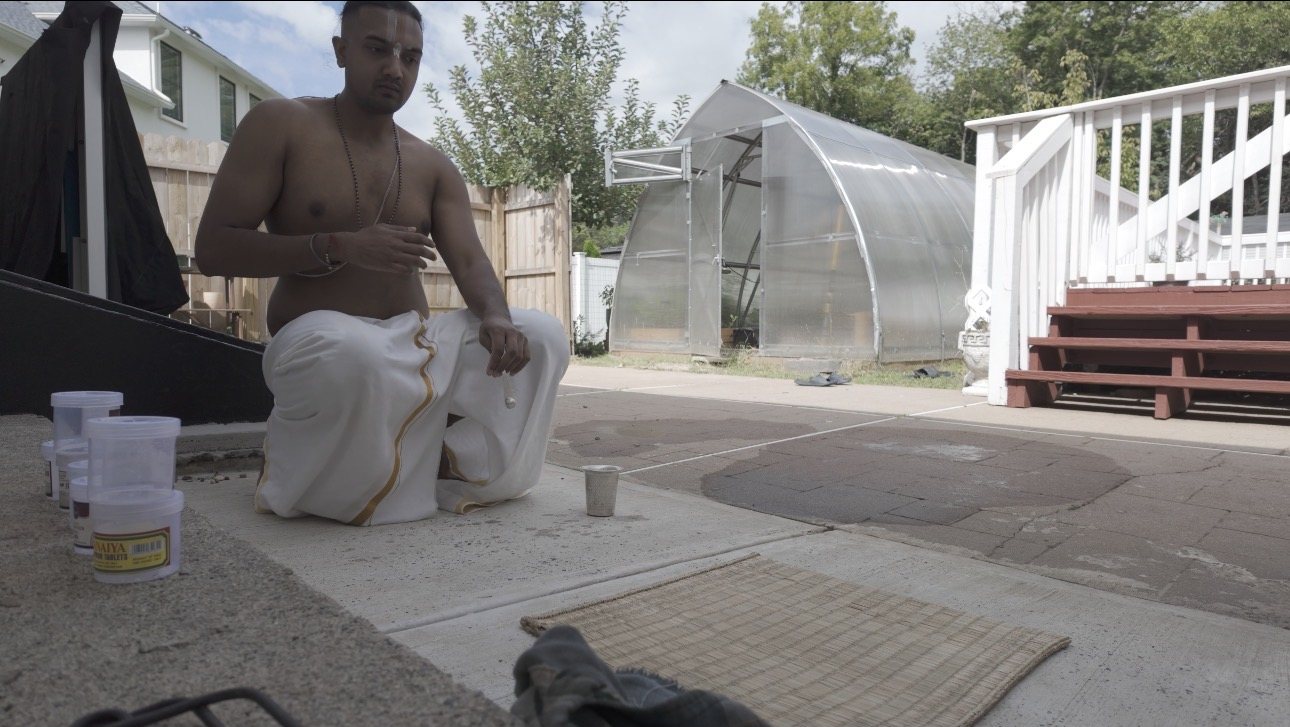
So here is the answer I should have given. I do many rituals when I wake up, and many more through the day. In my tradition, it is not auspicious to do them without the tilak on my forehead. Hence, it is the first thing I put on in the morning and I cannot skip it. In a way, it is like dressing for the office or suiting up for an event. Putting it on gets me into the right frame of mind for what comes next. Once it is on, I do not wipe it off when I step out of the house, and so it stays with me for the rest of the day. It also gives me a sense of belonging, and it shows my faith before I say a word.
Some people defend the tilak with science. They point out that it is applied on the spot of a yogic chakra, the ajna, between the eyebrows, and they say that it helps a person stay focused. There may well be something to this. However, I do not like to defend my practices with science. Science cannot explain everything, and it should not be asked to. Spirituality and religion, in my eyes, are not questions for science to answer. I wear the tilak because my tradition asks it of me, and that reason is enough.
The professor’s apology also taught me something. She was not hostile, only unfamiliar, and unfamiliarity is far easier to fix than hostility. Hence, every question is one more chance to explain, and every explanation makes the choice clearer to me as well.
A dharma that is chosen must also be held firmly. One thing I admire in the followers of other religions I have met is how faithful they are. Many of them pray at fixed times, keep their fasts strictly and speak about their faith without hesitation. I often wonder where this comes from. Perhaps part of it comes from the belief in one life and one final judgment. Suppose a person believes that they get only one chance. In that case, I can imagine that every day would carry great weight, and devotion would feel urgent. We, on the other hand, believe in many lives. Seen from one angle, perhaps this gives us more patience. However, I sometimes feel that this patience can slowly turn into putting things off, at least in my own case. Hence, if I could take one good thing from others, it would be their dedication.
At the same time, I do not think our tradition is weak because it is patient. The Vedic tradition carries one of the deepest philosophies in the world, and yet it is in no way soft. It asks for a strong mind, one that can question and reason and still believe in a higher reality. It is also mature. Ahimsa is its ideal, but ahimsa is not absolute. The tradition allows force to defend dharma, and the Gita itself is spoken on a battlefield. This point is easy to lose, and yet it is exactly what makes the tradition both peaceful and strong. Hence, a follower of Sanatana dharma does not seek to harm others, and does not stand aside when dharma must be defended.
This matters more now, because the climate around Indians in America is changing. According to the Network Contagion Research Institute, anti-Indian posts on X nearly tripled in 2025 compared with the year before. It found about 24,000 such posts, which together drew more than 300 million views (“Online Anti-Indian Hate Surge”). Most of us have not faced this in person. However, it is no longer something we can ignore. A tilak, a veshti or a fire in the backyard can draw a question, and in this climate the question may not always be as kind as the professor’s. Hence, those of us who have chosen our dharma will need to explain it clearly and, when needed, defend it firmly.
I do not know, clearly, what the next decade will bring for Hindus in America. But what I do know is that I will keep walking out to the greenhouse, even in the snow. The agni there is small, and nobody sees it except my family. Even so, it is the salt in my day, and it is salt that I have chosen. Without it, everything else would still be there, and yet nothing would taste right. Dharma was, is and will be the salt of my life, here or in India.
Sources
- “Online Anti-Indian Hate Surge: NCRI Report Highlights Rising Rhetoric, Influencer Role.” The Tribune, 11 Mar. 2026, www.tribuneindia.com/news/usa-news/online-anti-indian-hate-surge-ncri-report-highlights-rising-rhetoric-influencer-role/.
- Pew Research Center. “Hindus.” Religious Landscape Study, 2025, www.pewresearch.org/religious-landscape-study/religious-tradition/hindu/.
- Pew Research Center. “Religious Practices.” Religion in India: Tolerance and Segregation, 29 June 2021, www.pewresearch.org/religion/2021/06/29/religious-practices-2/.